Monday, September 10, 2012

Por Todo Mal Mezcal

It has been a while, and I will not try to fill in the gap, except to say that life has been busy with three new grandkids (two in California and one in Chicago), involvement in local things like the neighborhood group and the indigenous ladies in Huimilpan, my art, and lots of friends, fiestas and cultural activities.


This past weekend C and I visited San Luis Potosi (SLP) for the first time since 2006 when we decided we would not like to live there as it was too run down, with nothing much to see, and security seemed to be an issue. While I still do not think we would want to live there, we may have been a little to hasty about the general conditions and the lack to interesting things to see and do there.

A month ago a friend, James, from Atlanta who started the Dekalb County Historic Preservation Commission in the 1990s came for a visit, and together with his wife Carol I went to the Mexico ICOMOS (International Council on Monuments and Sites of UNESCO) conference in Toluca.  James was also attending the international meeting of ICOMOS’ legal commitee. 

At the conference, a friend from San Luis Potosi, Miguel, who is an expert on the manufacturing of mezcal, announced that he was heading up a month long celebration and educational program on mezcal. Mezcal is a distilled alcohol from one of the many agave varieties (known locally as maguey) of which there are about 150 in Mexico. Tequila is the best known variety of mezcal based on better public relations, more modern distillation methods, and the predominant use of the blue agave, giving it a distinctive flavor.  Most people associate the name mezcal with the agave alcohol from Oaxaca which has a strong smoky flavor, although the largest manufacturers of mezcal are probably in the SLP, Guerrero, Puebla, Hidalgo areas.

The basic method of mezcal manufacture consists of collecting the piña (“pineapples”) of the maguey plant (sometimes called century plant in the US southwest), by cutting off the large pointed leaves revealing the core of the plant which contains the agua de miel (“honey water”).  Traditionally, these piñas are then roasted and crushed under stone rollers to extract the juice. The juice is then allowed to ferment for several days, and once it has fermented it is filtered (more or less) and distilled in a traditional alambique  (alembic or large copper kettle with a constricted top and a tube leading off of it to extract the alcohol).  More modern methods have been introduced since the early 20th century, including better filters, modern crushing or pulverizing machines, and modern distillers, although these have been used more for the tequila variety, and mezcal has tended to be more traditional.

Miguel’s program consists of a series of Friday evening academic colloquia on the history, culture and manufacture of mezcal and a Saturday tour (7AM-9PM) of the mezcal regions of SLP, including visits to agave fields, as well as to traditional and modern manufacturing plants.

This weekend we joined the tour.  The Friday evening colloquium was on distillation patents in the late 19th-early 20th century, historic distillation methods from Europe and Asia that were brought together in colonial Mexico, and other topics, plus talks by two manufacturers of mezcal illustrating the differences between traditional and more modern methods of mezcal manufacture. The following day we visited the plants of these two speakers.

One of the more curious aspects of the tour was that we were accompanied all day by a four piece band playing ranchero music.  Wherever we went they followed in a pickup and began playing, whether it was in the middle of a maguey field, in a plant, at a hacienda. It was a little surreal, like the Mexican movie Herod’s Law and other recent Mexican movies.  There was always this ranchero background music to everything. Of course there was always a lot of mezcal being passed around to fill up the little Mexican clay cups we all had hanging around our necks. After a while, it became a little hard to tell the real from the surreal.


Ranchero band in the maguey field
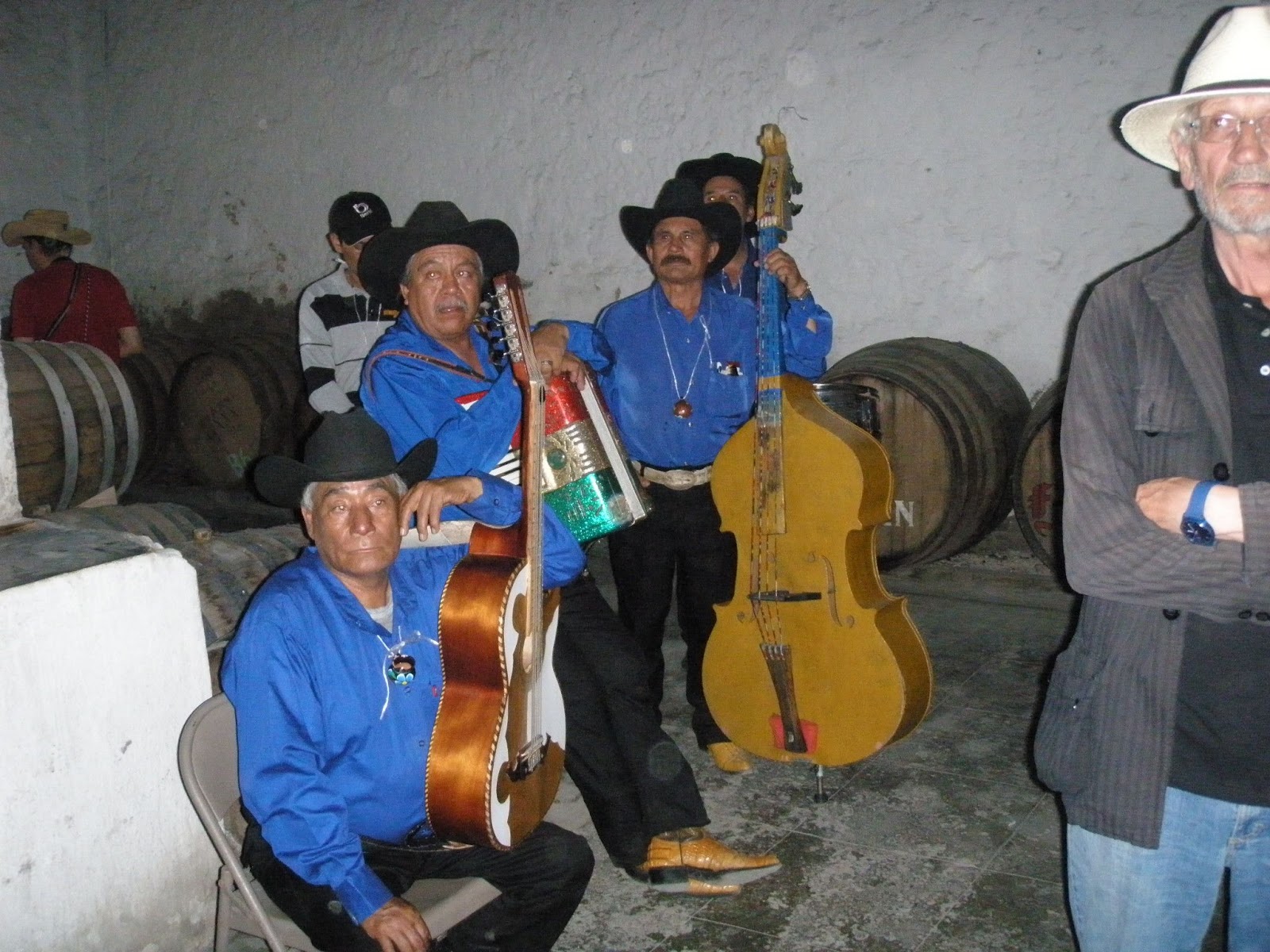

Ranchero band at Laguna Seca Plant, note the little mezcal cups around their necks.


Ranchero band at Zaragoza de Solis Plant


The first plant we visited is owned and operated by the Zaragoza de Solis ejido (communally owned indigenous town) a 2.5 hour bus trip from SLP. The mezcal made here and at the second plant, nearby Laguna Seca, are from a local variety of maguey that grows wild rather than in neat rows like one sees around Querétaro, Jalisco and Puebla, and even in Oaxaca.  One therefore finds a mix of immature and mature plants in the landscape which makes collecting it a very labor intensive job.


Immature maguey with evidence of red worm infestation


Maguey field and me with my little mezcal cup


The wild maguey is also infested with little red worms which zero in on the honey-water in the piña.  These worms have become a delicacy worth thousands of pesos a pound in Mexico City restaurants. So the locals are trying to make money off both the worms, which destroy the maguey, and the mezcal which requires healthy maguey.  This conflict of interests prevents either product from really being harvested efficiently. And the whole system relies on very, very cheap labor.  One gets the impression that they should devote some fields to worm production and others to mezcal kept free of worms and more amenable to row crops. And it is clear that once workers begin being paid better the price of the worms and the mezcal will sky-rocket, or they will go out of business.


 Red worms infesting the piña of a maguey


Worms collected from a couple of maguey plants


She actually ate it raw, but normally you fry them first.


Curiously, the indigenous operation at Zaragoza de Solis is the most modern mezcal operation, perhaps in Mexico.  Rather than roasting the pineapples and crushing under stone rollers to extract the juice, they have a modern, stainless steel grinding/threshing machine that directly extracts the juice with no roasting. This means they can process several hundred kilos in a few minutes rather than wasting days roasting and crushing the piñas. The juice is pumped directly to a modern filter system that removes most of the impurities.  From there it is fermented, filtered again to get 99% of the impurities, and then run through two distillers. Finally, the finished mezcal is stored in a 4,000 liter stainless steel tank awaiting bottling. The plant produces about 500 liters a day of high quality mezcal with a rounder flavor than tequila, but not as strong a flavor as Oaxaca or traditional mezcal. The ejido has not been slow to market their product either. They have been marketing to the US and Europe, and a German group just offered to buy 500 liters a month at whatever cost the ejido decides is fair, which is considerably more than in Mexico.  The price of 3/4 liter at the plant was $100MN or about $7.50 US.  At the end of the plant tour, we were treated to a snack of guacamole and fried worm tacos, which C and I did not take advantage of, and of course, the mezcal was flowing into our little ceramic cups all backed up by increasingly loud ranchero music.  (They were provided with mezcal too.)


Modern distillery at Zaragoza de Solis


The village of Zaragoza de Solis


The second plant was 15 minutes up the road at Laguna Seca.  This is a large mezcal plant, much larger than the little mom and pop outfits in Oaxaca that you may be familiar with.  And it has been in operation in the same buildings for 400 years!  Inside the buildings one can see the progression of technology over the centuries, as they have simply added new equipment next to the old which is then abandoned but not demolished.  This is common in a lot of places and industries in Mexico, where one can often see the progress in technology in a single plant or building.  However, the basic method used has not changed too much since the 17th century.  They still roast the piñas although in large industrial sized furnaces, they still use stone rollers to crush the roasted piñas although they now import the stones from Chile and use a John Deere tractor instead of mules to pull the rollers, they still use a press like a cider press to filter the juice, large open vats to ferment the juice, and an alembic with a combination of copper and stainless steel to distill it.  This plant also uses the wild maguey variety of the region which gives the mezcal from this area a characteristic and pleasant flavor.  While the mezcal from Zaragoza de Solis is purer and made with more modern and efficient techniques, I preferred the taste of the Laguna Seca product, which is more flavorful than Zaragoza, but not heavy and smoky like Oaxaca.  Laguna Seca is one of the major mezcals in Mexico and for export.  A full liter cost only $85MN or about $6.50 US.


Alembic of copper with steel top at Laguna Seca, not much changed in 400  years


A more "modern" condenser at Laguna Seca


Stone roller and basin powered by a tractor


Older crusher/filter at Laguna Seca


After the plant tour we had a late, by US standards, lunch in the 400 year old plant with plenty more mezcal and even louder ranchero music to which half the folks and even I, on one song, sang along. As the sun began going down we boarded the bus and headed back to SLP, exhausted and just a little borracho.  It was an excellent day and very Mexican, because as usual we were the only gringos.

Saturday, July 04, 2009

France 2009


The following is the introduction to the photos I have posted to Flickr on our trip to France in June. For the pictures and comments on our trip click here http://www.flickr.com/photos/tomwheaton/sets/72157620734856737/

We made the grand tour to France in June to visit the family starting in Chatou (Yves and Mado), next to Paris (Erwan), then to Nantes (Marie-Francoise and Jean-Charles, and Yves and Marie-Bernadette, and Daniel and Chantal), then Aix-en-Provence (Michel and Simone), then Nice (Jacques and Michelle) and back up to Valence (Bernard and Evelyne) and Chatou with a side trip to Gif-sur-Yvette to visit old friends (Jeanne-Marie, Jeanne-Marie, and Daniel), and finally to Fountainebleau (Eric and Sophie) before taking the plane again at Orly. Christiane has a big family.

These photos pretty much follow that itinerary.

The first week in Chatou we had sun for two days, the second week in Nantes we had two days of sun, and finally we had sun for two weeks in Provence, although there was a mistral held in our honor. Queretaro weather looked better and better.

I was able to walk out of the house in Chatou (when it wasn't raining) and in 10 minutes paint where Renoir and his Impressionist friends used to hangout. In Nantes, the Erdre is a block away, and I could paint river scenes within five minutes of the house, and in Ventabren, next to Aix, and in Nice, I could just paint from the bedroom window and catch the same light with the same greens that Cezanne did. Very nice.

Back in Queretaro, C has now implemented my new diet of no more French bread and Breton butter; aperitif time is now over, along with pate de foie gras time. Back to enchiladas and Marques del Valle, which I must say I did miss, but . . .

We had a great time and a lot of laughs and visits to places only locals know. An exceptional vacation and an exceptional family.

Thursday, June 12, 2008

Odds and Ends

Yesterday, they shot some scenes for a telenovela (soap opera) in Plaza de Armas. Click here for some shots and description. Later they moved to the andador (pedestrian street) on 16 de septiembre, our old street; and shot some more. They may be here still. Kind of weird having someone film places you walk to every day.

We had been told there was a birthday party for Julien in our old apartment complex the other day, but it had been cancelled (we forgot to check our e-mail before going) so we visited Luc and Sylvia instead. They had recently returned from a trip to Guatemala where they hiked around Lake Peten and visited some really interesting towns and archaeological sites in the jungle and along the lake. Luc showed me an archaeological site that had been worked on by National Geographic last year. They left the site a mess, with units and tunnels into temples still open.

Pot hunters know where to find the good stuff, but leaving everything open and making it so easy for them is totally unprofessional. No wonder it is hard for US archaeologists to get permits in Mexico. I cannot blame the Mexicans or anyone else who wants to prevent such damaging behavior. Check here for some photos.

The rainy season has really gotten started. Mexico City and Guadalajara have had floods, and we have had a few days of rain. This means the ants are starting to come out. So I have had to spray the wood beams in the living room ceiling with an insecticide. We may have to get an exterminator to seal off the ceilings and gas them, which seems to be the only really effective way to get rid of ants, but it costs a fortune.

I visited Bob and Maria's patios yesterday, just before the rain started. They really have some nice plants, and they are all so healthy. It's almost as if they have not had the same broiling sun we get in our patios, though things should improve now that the rainy season has begun. We put in an Italian cypress (the tall thin ones) in the main patio, replacing the gardenia which is about dead. I hope the cypress grows above the roof, a vertical statement in an otherwise horizontal patio. The dark green against the ochre yellow walls really looks pretty cool.

May is visa renewal month for us so we went to immigration at the beginning of the month, and we are still dealing with the fallout a month and a half later. You may think you have run into bureaucracy, but they have taken it to a new level in Mexico. Here is a synopsis:

May 2, 2008
Took all necessary papers (originals and copies), passports, visas, bank balance, and a letter in Spanish soliciting visa renewal to Gobernación (the Department where Migración is located). Arrived in late morning, took a number, waited about an hour and a half to see someone. Other people kept jumping ahead of the line.

Were given forms and told to pay the fee and return after May 5 (Cinco de Mayo). That afternoon I went to our bank and paid the fees.

Gobernación would not accept our bank statements even though we have a joint account, because C’s name was not on the statements. So I finally got a letter from the bank saying that it is the bank’s policy to put only one name on account statements and checks. I was lucky that I have a premium account so I could speak to my “own” representative. As it was, it took nearly an hour.

May 6, 2008
Took all the papers, plus the receipts of payment to Gobernación at 8:30AM, half an hour before it opened. Waited about an hour. We turned in the letter from the bank on our joint account.

Were told that the fee receipts were wrong, and they could not be changed in Gobernación’s computers. The mistake was that the bank form required a Razon Social, and the Gobernación form showed Razon Social as “retiree”. The bank then made out a receipt for “Thomas Riley Wheaton, retiree”. Gobernacion would not accept the retiree part. So we had to pay again, hoping we would get reimbursed for the first mistaken payment later. BTW, they do not accept money at Gobernación since they do not trust their employees, thus the business about paying at the bank.

We went to a different bank and paid again, making sure they did not use retiree. We returned to Gobernación half an hour later and successfully turned in our paper work. We got an appointment for May 14 to visit them again to make sure all the paper work was correct and/or to pick up our visas.

May 14, 2008
We arrived at 8:30 and were the first ones there. At 9:00 we were informed that they had not had a chance to look over the paper work, and to come back the following week, or to call first.

May 21, 2008
I called and was informed that they still had not had time to look over our paper work and to call back on Friday.

May 23, 2008 (Friday)
Called and was informed that our visas were ready. Arrived at Gobernación at 9:45, and waited until about 11. The visas were indeed ready and after signing everything in sight, I got them. Then I asked about reimbursement for the first mistaken payment. It took about 5 minutes for the lady to give me a letter and the necessary paperwork. I was blown away at how quickly she handled it. She said we should then go to Hacienda on Calle Allende to get our money.

Around 1PM, C and I went to Hacienda, and were informed that we had to buy a form from a paper store, fill it out, make an appointment by phone with Hacienda.

I bought the form (which was mostly unintelligible acronyms), and called for an appointment, which was not until June 9!!!!

June 9, 2008
We went to Hacienda with the forms completed and all the paper work from Migración. More or less on time, we met with the person about our refund. He was confused at why we had two refunds, and why they were both in my name. Since I had paid, the receipts were in my name even though one of the visas was for Christiane. He was also confused at why we both had the same last name if C was my wife and not my sister. We finally got that all sorted out, and then he needed ID to make sure we were who we said we were. I gave him my Mexican driver’s license, but C did not have any Mexican ID (since I am the one being reimbursed it did not seem necessary for her to need ID). So we had to walk back home, make copies of our passports and visas. I even made copies of a utility bill to prove we lived at our house (sometimes required even if the bill is not in your name, go figure), and a copy of my driver’s license just in case. We returned to Hacienda and turned in the paperwork after an hour’s wait since we did not have an appointment. The guy took everything and told us to expect a check or voucher within 90 days!!! When pushed, he said that it could be longer than 90 days or maybe less. If we ever get a reimbursement check I will it announce here.

Wednesday, June 04, 2008

US News, the Mexican Report

People seem to think that because we are in Mexico we do not know what is going on in the states. During the recent, prolonged primary season, people would say that it must be nice to be in Mexico and not have to deal with the idiocies of the campaign, or since we are in Mexico we did not really understand what was going on.

Contrary to what you might have expected 20-30 years ago, I have never been so well informed about a campaign. We get CNN (based in Hong Kong and mostly about Asia), TV5 (French, with better world coverage than CNN and better Latin America coverage than BBC, which we no longer get), CBS evening news, and various Mexican channels. But except for primary nights, TV is not very enlightening, even in the US.

Mostly, we get our news via the Internet, and more importantly we have the time to read the New York Times, the Washington Post, Time Magazine, the Atlanta Journal and Constitution for “local” news, Le Monde, Le Figaro and nearly every other paper in the world we want to. I have RSS leads to stories I follow, such as politics and the situation in Zimbabwe and Mexico. We read local and major Mexican newspapers nearly every day (no home delivery), and there is a Mexican English language paper supported by the NYT. We also have connections to all the NPR stations around the US, which I usually do not listen too since I used to listen to NPR in the car, and it is hard to get used to listening to it when I am doing other things. But we do have All Things Considered and Morning Edition if we want, plus I have RSS leads to their major stories.

I was lucky to read the newspaper and watch some CNN when we worked in the states. Now I have all day if I want to read up on something, and I probably spend too much time doing so.

I would say that I am better informed here than I ever was in the US, even about people’s individual stands and issues, as I read the letters to the editor of many papers and the occasional blog (although most of the blogs are worthless). I also discuss politics through e-mail with a bunch of folks from around the country who are not retired, but who seem to have an awful lot of time on their hands (you know who you are!). And lastly, there is a well-educated and well-informed group of retired Americans and Canadians in Querétaro who really do have the time to read and talk about the issues at one of various cafes around the city.

This is the 21st century, not the 1960s in Africa or the 1970s in Mexico. Folks overseas are not out of touch any more.

What really disappoints me is that Americans are so out of touch with the rest of the world, even if they also have the Internet. The NYT had an editorial on why the US should help Mexico in the drug war, and the response of presumably educated and well-informed NYT readers showed an incredible lack of understanding of the issue, of the US’s interest in the issue, or of the situation in Mexico. This seems to be especially true of people from states along the border who, because of being next to the border, think they know Mexico, but have a twisted idea of what Mexico is all about based on Nuevo Laredo, Tijuana, etc., and maybe Lou Dobbs. Sort of like making conclusions about the US based on Detroit or Brownsville and Lou Dobbs.

Friday, May 16, 2008

Marcos y Molduras - Frames and Moldings

My art teacher told me about a place for inexpensive, but not cheap, frames. The prices are as low as the place on Ezq. Montes I found a few weeks back, but the place is a real frame shop (they do all the work there and have all the equipment and materials). Most frame shops here are very expensive. They also have a collection of paintings including water colors, some of which are very nice. After I talked to the lady (wife of the owner) about costs, I checked out the paintings; and ended up talking quite a bit with owner, Raúl Chavez, no relation.

It turns out the shop is mainly a place for the students from his school, and that is why things are less expensive. After I noted that I liked one of the watercolorists in his collection (turns out the guy died 3 months ago, so he is no longer teaching, or painting, for that matter), Raúl mentioned that he was at one time in Diego Rivera’s circle. I mentioned that Niels had a connection to that circle through Siquieros, so the guy took me a little more seriously. He currently has a Siquieros that belonged to a president, and the family is now selling off his stuff. I need to find out which president. Mexicans would never ask, but I can get away with it since I am a bold, brash gringo. I think it sold for $100,000 MN and had been part of a mural from the school the president attended.

He also just sold a possible Rembrandt which he had taken to the Rembrandt museum in Holland for authentication. C-14 showed it was the right age, it was from his workshop, but it is impossible to prove it was painted by him and not by a student. The museum has run into problems attributing paintings and is now very gun shy. I think that that one went for $1,000,000 MN, because now it is just an old picture, although it may be one of several "lost" Rembrandts, a self portrait!

He also showed me a Chucho Reyes and told me the story of the painter. In the late nineteenth century, Chucho’s (not El Roto) parents imported stuff from the orient and wrapped it in rice paper which they also bought from the orient. He used to paint on the paper, and then his parents would use the paper to wrap things and fill empty space in boxes. Most people threw the packing paper away, but some recognized it as real art. Later he became a fairly well known artist, travelled the world and exhibited in Mexico City where he had a uniquely decorated house. His rice paper paintings now start at $20,000 MN and look like they could have been done today. They are very modern. Google Chucho Reyes on the internet. And click on "Liga a la galeria" at http://sepiensa.org.mx/contenidos/2006/l_chucho_reyes/chucho_1.htm to see some other pix.

It seems Raúl knows all the major collectors in the Queretaro area, and just calls one or two people when something special comes in, and it sells in a day or two. Paintings might be available for viewing while he is framing them, but not for long. I asked to be put on his e-mail list to be notified, but since things sell so fast, I may never get to see any of them.

If I could get him to sell my stuff I would have it made since he seems to be held in high regard by local artists and collectors. But the quality of the artists he represents is really a bit beyond me, at least for the next 15 to 20 years.

Saturday, May 10, 2008

A Quick Update

We (at least I) are enjoying the quiet in the house. No guests for two weeks!! The next round will start at the end of June when Bill and Mary from Atlanta will come for a couple of days. I am really looking forward to seeing them, and hope they don’t change their minds. They will drop by to see us before working at a community development volunteer project in Michoacan. Maybe they should join the Peace Corps, I can put in a good word to Byron.

It has been HOT. Since a week or two before the Famille Française came, it has been in the low 30s celsius, 90s in fahrenheit, and we keep hoping the rainy season will start. Last night, we had a really good storm and the lights went out, so maybe we are finally going to change to the other season. But with low humidity, it is always bearable in the shade, and the nights get into the 10s celsius, 60s fahrenheit.

During a break in the storm we walked down 5 de Mayo 2 or 3 blocks to the Galeria D’rte for a vernisage, I don’t know the word for the introduction of a new musical CD, and the galeria is for paintings anyway, by Carlos Sanchez of a new CD of popular music. Carlos is really a great baritone with an incredible voice and well known in Mexico and especially Querétaro. His previous CDs were opera and bel canto. We ran into Niels and Grace, and Ramon (Elvira was visiting near Acambaro or something). We also ran into Renatta who owns the really neat furniture and artesanias store next door to the galeria. Chris, her husband, was home taking care of the baby. I finally got to see their new house a week or so ago. They are fixing up an old house in the historic district, and the living, dining, kitchen will be a spectacular place to have parties.

I was very impressed with all the politicians who attended the vernisage, former mayors and governors, only one of whom had we met, a former governor, at Sol’s house in Jurica at another of her daughter’s rights of passage celebrations. Renatta was NOT impressed by the politicians, however.

Niels ended up talking to an ex-violinist in the Querétaro symphony whose wife is first cellist. So I finally got to meet this guy who is head of a very good quartet made up entirely of Russian ex-patriots. Turns out he is now working in Morelia and only comes home on weekends, which answered my question about why we no longer see him in the Querétaro symphony. Niels wanted to speak Russian with him, of course; and then he wanted to speak Russian to me. We cut off his wine at that point! ;-)

When the rain stopped again, we walked home. Wow, Querétaro is great.

My brother Bill is having his 50th today, May 10. My brother-in-law, Jacques, in France is having his birthday today too. He is a little more than 50, but with a recent triple bypass, he is feeling younger.

Michel (Miguel to all the Mexicans) decided his house in Provence was a little plain after visiting us, and has now bought flowers in pots for his terrace. Nice to be an inspiration.

Watercolors are coming along. I have posted some new ones with a somewhat looser style, hope my art teacher, Jorge, likes them.

Pierre and Sophie who, with Antoine, were our last visitors, have decided to buy a house in Querétaro in the historic district, and more specifically on Sangremal hill, the only hill in the district and where we live. Laura A. has been helping me by calling people with houses for sale with her real Mexican accent to make sure we get a non-gringo price. We saw a really nice one about a block from our house that is ready to move in to, but Pierre and Sophie will probably want to make some changes eventually. I can hear the groans about a new house saga, but I hope they go for it.

And life goes on in Querétaro. If you want to know what C is up to, send her an e-mail and ask her to start her own blog.

Happy Mother’s Day.

Friday, April 18, 2008

Encore!

Wow! Tonight we went to the opening concert of the Querétaro International Guitar Festival. It is the third time I have attended the opening concert (Christiane missed it last year because she insists on teaching evening French classes), but at least Ramon was there. It must be his 15th. But Elvira wasn’t. Women just don’t like guitar music, I guess.

The opening concert, as with the last two years, was with Hilario Yañez, the rising young classical guitarist of Querétaro and San Juan del Rios. He played the usual repertoire of Villa-Lobos and Leo Brouwer, nice, but becoming a little tiresome (sorry Hilario), and then he played, with two violins, a viola and cello, Bach’s concierto in Re Major, adapted to the guitar. Spectacular! Standing ovation! Encore! I think he was surprised and a little pleased at the reception. Every year Hilario gets better.

This year, not only did he get better (hard to figure out how he could get better, but he did) he also had his new Paracho guitar. It probably cost 6 month’s salary at the Guadalupe Velasquez school where Hilario now teaches. Ramon, the usual American suspects, and Christiane and I thought this was the best concert yet, and we wonder how he will improve on it next year. Even the event organizer, Ramiro Martinez, who used to live in the house Bob and Maria bought and fixed up this year, thought it was great. There was truly a sense of something special in the air. Christiane says that Hilario’s concerts will now be in the Teatro de la Republica instead of the Museo de Arte, and they will start charging. I hope so for Hilario’s sake, and I will gladly pay to attend, but I really enjoy the free concerts, not only are they free, but they are great at showcasing developing talent.

I think this is Hilario’s first attempt at a concierto with strings, at least in public. I think it points to his future. I would love a recording. I just hope he reads this.

Prior to this concert, Hilario was renowned for his previous appearances at the festival, of course, but also for playing at Caroline’s wedding in December and our house-warming in August. But the most fun was when he played dueling guitars with Ramon and Felipe, Danny’s uncle, in our living room after the wedding. Ah, the simple pleasures. Now if I could convince Mamita and Nathalie to play a little concert for my birthday, maybe with a little classical guitar thrown in, that would be truly splendid.

Mexico City and Teotihuacan

La famille française, Michel, Ridette, Simone et Yves, took a rest day in Querétaro before we headed off to Mexico City (known in Mexico as the D.F. or Distrito Federal), by bus this time. It took us over an hour to get through the D.F. on our way back from Oaxaca, and I was not going to chance getting stopped by a D.F. policeman and having to pay an exorbitant mordida. I also admit that I cannot find my way around Mexico City by car any more. I do much better by metro or taxi; or the occasional Mexican friend.

C and I spent three days and two nights in the D.F. and left la famille française on their own to get to the airport the last day. After a double decker tourist bus trip around the D.F. we visited Teotihuacan the next day by taxi, which is not too bad for six people. La famille were pretty good sports about visiting yet another archaeological site during the hottest April in 100 years. We also visited my favorite museums, the Templo Major where the main Aztec temples were when Cortes arrived, and the National Museum of Anthropology which has the most complete and fascinating collection of prehispanic artifacts in Mexico, and the New World. Peru has some really cool museums, but they just cannot compare. The voladores from the gulf coast were performing in the park in front of the musuem. We also visited Xochimilco and the Dolores Olmeido museum where we saw Diego Rivera’s paintings and his collection of illegally stolen prehispanic artifacts that rival those of Tamayo in Oaxaca. I like Diego’s and Tamayo’s mural work, but it makes me sick to my stomach what they did to Mexican heritage.

While the girls and Michel visited the photographic exhibit in the Zocalo, and Yves finally took advantage of the siesta, I went to Calle Doncellas to look for used books on mining and the old mining town of Pozos. The street was mostly blocked by federales because of a planned demonstration threatened by people opposed to the privatization of the oil industry. I got past the barriers (I no longer look like a hippie drug runner, I guess), and there was not another customer in sight. I visited the Libreria Madero and asked the owner for books on mining. He is apparently a well-known character and raconteur. I did not find any books this time, but it turns out we have friends in common (Marco and Belem in Pachuca), and he gave me some leads that I will follow up on. Despite the security around the Senate, it was a productive little visit.

BTW, Michel bailed out of the Zocalo photo tour about halfway through. Only Yves believed me when I told them about having seen the video with Laura in Jurica and that it was really not worth the long lines and heat. Oh well. They pretended to listen to me, but I suspect they do not remember anything about Mexican archaeology except that the rain god Tlaloc (Chac in Yucatan, Cocijo in Oaxaca) had big eyes and a big mouth, like me.

I have uploaded some pictures of Xochimilco to Flickr with an explanation of what Xochimilco is. I will add some other pictures of Oaxaca, Mitla, Cholula and Teotihuacan soon.

A Busy Month or Two

We have had guests since before Christmas, with a week or two off. The day Delfina left for Peru, Jeanne Marie (originally from Atlanta) came from Houston for Easter week. Daniel is teaching there now. Luca is finally there too, and who knows, they may spend the rest of their lives in Houston. I guess it must kind of grow on you, but I find it hard to believe that well-traveled, intelligent, highly-educated, and cultured people from France and Italy could really be happy there. I must have missed something.

We took Jeanne Marie to Guanajuato, Bernal, and San Miguel to show her the other (the non-Mexico City) side of Mexico. And we attended the march of silence and the way of the cross in Querétaro. After she left we spent the week getting the house ready for Christiane’s sister, Marie Bernadette, and her brother, Miguel, and their spouses, Yves and Simone. I hung plants, planted the garden with some annuals, cleaned the cat poop off the roof, vacuumed the patios, watered and fertilized everything, and made sure all the toilets were flushing properly, a bad toilet can ruin a vacation. I don’t know what Christiane and Emelda did.

The big day arrived, and we had successfully convinced them that they could find Querétaro from the airport without our help. Yves even used his French cell phone to tell us when they were getting close to town so we could go and pick them up at the Terminal de Autobuses. While we were waiting, we ran into Walt and Nancy, two Peace Corps volunteers in Querétaro (it seems the same generation that started the Peace Corps, mine, are the ones keeping it going 40 years later.) I wonder if the Peace Corps will disappear with the last baby boomer. Byron, what are your thoughts on that?

After a couple of days of “orientation” in Querétaro, we rented a minivan and headed to Oaxaca, or as Miguel said, Ohacaca, Oah a a ca ca, whatever. This was our first visit to Oaxaca since 1975 or 76 when we visited with Steve and Sue and their baby, our two daughters and our dog. We were surrounded by federales with machine guns on our way back from Mitla to Oaxaca city and almost arrested for being hippie drug runners. Steve and I did have beards, and we were in a VW bus, but we had kids and a dog for Christ’s sake. I normally did not speak Spanish to police, but that time we all spoke Spanish as fast as we could, and the kids did too. Fortunately, Mexicans love kids. We were sooo young then, so young.

The first thing we noted was that Oaxaca (pronounced Wah hah kah) had grown. Etla is practically downtown, as is Monte Alban, Atzompa (green pottery), Coyotepec (Doña Rosa and black pottery), Zaachila, Cuilapan, El Tule, and a bunch of other places known mostly to archaeologists, anthropologists and the people who live there. Archaeological sites Yagul and Lambityeco were a little way out of town, but now have towns around them. Teotitlan del Valle (rugs) has grown incredibly. It now specializes in weavings with organic dies, a concept that was new 35 years ago. In 1974 or 75, we took a weaver from the market at El Tule (the world’s largest tree, a cypress, around which there has been a market for over 2000 years) to his house. He was one of the very first to start using dies from native plants and insects (cochineal), collecting the wool, carding, making yarn, dyeing it, and weaving his own designs based on prehispanic stamps. (Wow, is that cool, or what?) Now everyone is doing it. It is pretty, but somehow lacks the charm and adventure of 35+ years ago. We bought a rug, of course.

Together with la famille we visited Monte Alban. Everyone kept waiting for me to tell them what to do. It took a few days to get used to that. No one ever listened to me at New South.

I was actually surprised at how much I remembered from my three years of graduate studies (the best three years of my life, thanks to Peter and Paul, not the Apostles, the Schmidts, inside joke, sorry). We also visited Atzompa and bought some green pottery. Then we headed to Coyotepec at 3 in the afternoon. Nearly everything was closed, but there were a few stalls open at the pottery market, and after 35 years I finally bought a polished black pot. We were too poor last time. We also visited Doña Rosa’s where her son now makes pots. Must be in his 70s. There were pictures of Tito and Jimmy Carter and other important folks (no Bushes or Reagans though) on the wall when they visited.

We visited Mitla the next day. Mitla is a town I have heard of since I was in kindergarten. My grandparents used to visit us and show us black and white slides, and they always made sure we heard that you could not put a knife blade between the stones in the buildings since they were so well cut, and without benefit of metal! (Turns out they did not need metal or the wheel or beasts of burden.) I passed on the story to a new generation of French relatives. Hey, nothing like helping the poor Europeans learn a thing or two.

Mitla seemed smaller than 35 years ago, much like houses we lived in when I was a kid. It is, however, definitely worth a visit. The tombs are very interesting, if not as richly decorated as those in Monte Alban. The church built on the prehispanic ruins destroyed significant cultural resources (but no more than INAH’s little offices and museums though), but that is probably not the reason my grandparents, who were Mormon, made sure we knew about it. After their run-ins with the Catholic church in Yucatan, they were very aware of Catholic depredations, and wanted to make sure we were too.

We also visited sites in Oaxaca city, the cathedral, Santo Domingo church and cultural center, and the Tamayo museum. The latter had a collection of prehispanic artifacts that the muralist Tamayo (buddy of Diego Rivera, Siquieros, etc.) had collected and kept out of the clutches of INAH (my favorite governmental agency). Unfortunately by collecting these things, Tamayo had supported the grave robbing of perhaps dozens, if not hundreds, of tombs in the Oaxaca area. The American docent gave us a great tour, but I think that he too was a little dismayed that so much had been illegally collected and so much irreplaceable archaeology destroyed, all in the name of keeping what is pretty and pleasing. Tamayo was not the only one who should have known better to do so, however.

Miguel helped me drive, but mostly I was the designated driver. Despite what the folks in Atlanta may think, I only drank coffee.

On our way back to Querétaro, we stopped at Cholula (famous for having me as a student in the mid 1970s). We stayed at a hotel on the plaza, second in size only to the one in Mexico City, with a view of the largest pyramid in Mexico and perhaps the world, although Miguel thinks not. It is larger even than the pyramid of the sun in Teotihuacan, although it is hard to tell, as it looks like a hill with a church on top, rather than a man-made structure. We took a tour of some of the 23 kilometers of tunnels dug by archaeologists to explore the seven or so different building stages. We also visited the church at Tonantzintla (Nahuatl for Our Lady, which dovetails nicely with the Virgin, can you spell syconcronism?). This church is one of Mexico’s jewels. It is truly Baroque, but was built by Indians just after the conquest and incorporates native plants, fruits, animals and people into the gilt decoration. If you get to Puebla and Cholula, this is a must see.

We did not visit Cacaxtla this time as the roof that covered it was damaged by heavy rains last year. Christiane told me that it will be ready for the public in the next few weeks. It’s great to be able to read Mexican newspapers.

We made it back to Querétaro after missing the turn-off to Teotihuacan. The signs from Querétaro show the road and exit to Teotihuacan and Pachuca. Coming the other way there is no mention whatsover of Teotihuacan, the pyramids or Pachuca, the main town that would lead you to the pyramids. I could make a fortune doing signage in Mexico, but no one here has the money or seems to care. Heck, everyone knows where the Teotihuacan exit is, right?

BTW, Christiane pointed out that here brother’s name is spelled Michel, and not Miguel.

Monday, February 18, 2008

Three Weddings and a House

Nathalie got married to Benn in September in Chicago at the Garfield Conservatory, very nice. Chicago is much nicer and cleaner than I remember from 40+ years ago. One down, two to go. Check here for some photos.

Caroline got married to Danny in December. I finally got to walk a daughter down the aisle; we followed the Mariachis from the wedding hotel on Plaza de Armas to our house, New Orleans style; and we generally had a great time. For photos check here.

In October our niece, Marie, got married to David in Nantes, France. Check here for some photos.

With the house in Querétaro, it was quite a year.

Wednesday, December 19, 2007

Posada at New House

We had a posada in our street last night. Normally, a posada is when a group of people, representing Mary and Joseph, go from house to house asking for lodging. This tradition started in Mexico in the 1500s as part of the church’s attempts to convert the local population and teach them about Christianity. The posada season runs for the 10 nights before Christmas.


In preparation, people decorate the street in front of their houses by stretching punched paper flags, paper lanterns, and balloons etc. across the street. At 5 PM, we found out that the posada would be in our street, two hours before it was supposed to start; and no one had put up any decorations. A little past 6:00, our neighbors across the street, who do this every year and had previously asked permission to attach the decorations to our house, started to put things up. No one else on the street had even started. By 6:20, others had started; and by 7:00 when the posada folks had left La Cruz church, the street was decorated, but it was too dark to take a picture. The posada got to our house around 7:15, 15 minutes ahead of time. In the states, the decorations would have been up a day ahead, and I was getting a little nervous, being a gringo, an old grumpy gringo.


The people in the group coming up the street sing traditional songs asking the people in selected houses for posada (lodgings) because Mary is pregnant, and there is no room in the inn. The people inside sing the traditional responses asking who these beggars are, and saying that there is no room and that Mary should just keep moving on (not a direct translation). Reluctantly, the group outside laments that they have been turned down and have to keep going until they can find a house with a kindhearted owner, etc. etc. The songs are pretty complex, so there are printed versions passed out by the church if the posada is organized by a church or that you can buy in the market if you are doing it on your own.

In our barrio (neighborhood), the posada starts at La Cruz church (where Santiago and a cross miraculously appeared in the sky and the Spanish conquered Querétaro in 1531). Our barrio is thus called La Cruz. La Cruz church is also known for being where Franciscan missionary friars were trained and from where they left for indigenous towns now in the United States in the 18th century, and where Emperor Maximilian made his last stand and was then held prisoner before his execution in the 19th century.

The group in the street, often numbering from a dozen to two or three dozen get turned down at all the houses but the last. The group in the street grows as people from inside each house join the folks in the street, and the expanded group sets off for the next house previously selected to be a stopping place.


Our neighbors across the street were one of three selected in our block of Damían Carmona to “host”.


While I was trying to take pictures of the friars leading the posada songs across the street, a vendor poked at my elbow. I ignored her (I thought it was a her) and took my pictures. When I was done I turned around to the vendor and found out that he was one of my students, Christian from Niños y Niñas, selling sparklers. So I took his picture with Christiane and bought some sparklers which we gave to two little girls whose sparklers had burned out.

At the last house of a posada, the people inside sing that they have lodging and Mary can rest and eat. The people outside sing their thanks and everyone goes inside to pray and eat, meet the neighbors and break a piñata. In Mexico City and Puebla years ago, there was no praying and we went straight to the drinking and eating. I think praying is more of a Querétaro tradition.

In barrio La Cruz, they go from house to house asking for a place to stay, but at the end, instead of a party at the last house, they give all the kids a bag of goodies, called an aguinaldo, paid for by the people in that street. Last night, there were several hundred people, mostly kids, which is a lot more than at the gallos celebration or that we ever saw in Mexico City or Puebla. The people in the last house made up pretty sizable bags with stuff that people in the barrio had donated, like tangerines, peanuts, sugar cane, candy and other stuff. This reminded me of Halloween in the states, but here they have it 10 nights running. Some people donated money to buy the bags and helped to fill them. There is a whole organization to do this that is run along the lines of a mayordomia where a mayordomo is selected by the barrio or church group to run that year’s posada for each street.


In front of the last house, Christiane was greeted by a number of her students and another one of mine from Niños y Niñas who were patiently waiting in line for their aguinaldo while the friars were praying. It was a long wait, and they were very patient.

Barrio La Cruz is a little unlike many other barrios in Querétaro in another way too. After the aguinaldos are handed out people drift back home, but stop on the way to visit neighbors who have opened their houses and prepared fruit punch and food for anyone who comes by, kind of an open-house block party. It seemed that most people were handing out food and that there was a dearth of people to accept it. So we stopped at our next-door neighbors’ house and at our neighbors’ house across the street for something to eat and drink and a chat.

We learned all about our neighbors, promised to help out for next year’s posada, and found out that our house and those on either side had been lived in or used by General Carranza, an early 20th century president and his men. This must have been during the 1910 revolution known in the states more for Pancho Villa and Emiliano Zapata. You just never know what you will find out around here.

Friday, August 03, 2007

House Finally Done!!


We moved into our new house at Damián Carmona Norte #11 on July 31, 2007, a date that will live in . . . , well for a long, long time in our memories at least.

What a relief. If you have not looked at the Before and After shots recently, I added a few since I first put up the photos in Flickr. There are a few more flowers in these. The red of our bougainvilla and canas are really set off by the ochre of the patio walls. We really lucked out on colors.

We have been cleaning and organizing ever since, and are pooped. Miguel and Alberto did a great job and despite the extra couple of months and the extra couple hundred thousand pesos, we are very pleased with what they were able to accomplish. The old owner, Alberto G., has apparently been coming by to check things on "his" house, and I think he is a little surprised at what we were able to do with it and still maintain its historic nature. Every door (all are glassed) has a different and interesting view.

I also added some pix to Flickr that Celine (C's niece, daughter of Claude and Marie José) took when she visited us a few months ago. I just happened on them again and thought they provided an interesting look at Querétaro, especially since she was here for less than 24 hours. The couple at Hacienda Juriquilla are Niels and Grace.

Niel's father was the archaeologist who discovered Tepexpan Man in 1947, the earliest human remains in the New World until that time. We are having a 60 year retrospective at the Tepexpan Museum (near Teotihuacan) on August 23. I did the website with a lot of help from Niels. Check it out here.

Now if we can find some money to finish paying the Social Security of the workers, attending our daughters' weddings and another niece's wedding in France, we will be able to survive 2007. I would hate to have to sell this house to make ends meet!

And life goes on despite the threat of world economic breakdown, rumors of unrest in Mexico, and especially despite the fact that George W. is trying his level best to destroy what used to make the US great.

Sunday, July 22, 2007

House Update #6

On July 30 or 31, we will move into our new house. It has been a long 7 months since we started the renovations and an even longer 9 and a half months since we bought it, and it has been over a year since we made our first offer on it. Whew! I am tired just thinking about it.

Every thing is about finished so I went to the house today and took pictures based on what we saw before renovations began and posted BEFORE and AFTER shots to Flickr. I will post a few more next week after things get cleaned up a little more.

On August 18, we are planning on having a house warming with everyone we have ever met (well almost) in Querétaro, along with our architects, masons, electrician, some neighbors, etc. If they all come it will be well over 60 people.

This house is the nicest one we have ever owned, and more charming than most we lived in growing up. Only the one we lived in in Newport R.I. (near Cliff Walk) and the one my parents owned on Main St. Glastonbury, Connecticut (1745 Colonial), were nearly as neat as this one. It has a great mixture of traditional construction and basic layout with modern convenience and light. Our architect did a tremendous job of adding the nice little touches like the back patio floor and stairs, the rooftop terrace, and the skylights in the bathrooms and front bedroom; and he was very creative in adapting an old house to modern needs.

I just like to go there, with or without the workmen, and stare.

Tuesday, July 03, 2007

House Update #5

Since the last update (#4), about a month and a half ago, things have picked up speed as we have consistently had 10 people working. Click here for some recent photos.

All the tile in the baths and the kitchen; and the interior floors have been installed and grouted. They really look nice. The floors are of terra cotta tile and will need to be sealed, but that will wait until all the painting and other heavy work is done. The brick in the back patio is finished and a new drain has been installed. They are putting the quarried patio stones back in the main patio, now that the electrical and plumbing work is mostly done. We still need to install the light and plumbing fixtures. The light fixtures in the bedrooms, baths, study and kitchen will be modern; and in the living room, dining room and patios they will be traditional handicraft style which we bought in San Miguel de Allende, where there is really a wider selection even if the prices are a little higher.

We bought a new stove and a dishwasher which will be installed in the next week or so. The main question will be whether the gas company will accept our pipes or require that they install the pipes (on the outside of the walls) and hook up the stove and hot water heater on the roof.

The interior doors are all of wood, but since the doorways are all different widths and heights and because we want an “authentic” look, they have either been made by hand (hand hewn tongue in grove, all pegged together and no nails, and mortice and tenon) or are being adapted from the original exterior doors, which were also hand-made and pegged together. The carpenter has also repaired the original front window using the same methods as the original builder. It is really fascinating watching him work.

The doors leading to the patios will all be metal door frames with glass. And these are being installed even though we have not gotten the quarried threshold stones yet. It seems that the little village where the thresholds are being made has been cutoff from the outside world by the recent rains, making it impossible for trucks to get in and out.

All of the walls, inside and out, have now been stuccoed white, and only need to be painted. They look pretty good without paint. The 12-foot ceilings have all been painted.

The pergola on the roof was finished today, and they will start putting in the terra cotta floor tile tomorrow. We still need to tile the steps to the roof, put guard rails on the stairs and the puente (bridge), connect to the water tanks on the roof, put in the hot water heater, build and install the kitchen and master bathroom cabinets (by hand, of course), install the rest of the doors, put in the light and plumbing fixtures, paint, and few other things. We have told our architect and our landlord that we plan on moving in at the end of the month.

I hope they get it ready on time.

Thursday, May 24, 2007

House Update #4


The upstairs bedroom with a new little room for our tinacos (water tanks) on top. Note our neighbor's tinaco, not too pretty; and presumably against the law in new construction and renovations. But hey, rules are meant to be broken, right?

After a month lost to INAH, we had a reduced crew of 2-4 for nearly a month, slowing down the process considerably. We are now 2-3 months behind the original estimate for one reason or another. BUT- things are looking up. The main patio is still a mess, but the bathrooms are being tiled, the walls are being stuccoed and painted, and the floor tiles are being installed. Here are some pictures.

Birds seem to be a theme. For the front guest bathroom we selected a simple blue, bird design, and for the upstairs guest room we selected a green/blue, bird design. These talavera bird designs are pretty much straight from the 13th century when they seem to have found their way from north Africa to Italy to Spain. You can still find them in Morocco, or you could 40 years ago.

We have to wait for the tiles for the kitchen, half-bath and master bath since the tiles had to be ordered from Dolores Hidalgo (la cuna de la revolución). They are really nothing special, but they make tiles down here as they are needed, all hand-made of course. The kitchen counter and wall designs will include yellow birds on a red background for highlighting and yellow tiles for the counter top. Most new "traditional" kitchens here seem to be bright red, blue or green, but we liked the yellow tiles which have a nice glow and warmth to them that you often don't get in recent Mexican kitchens. And besides we just did not want to be like everyone else.

The tiles in the half-bath in the study will have an abstract cobalt blue design on natural terra cotta, with an off-white tile for the counter top. We will not tile the walls, which we can do later if we want to.

Our master bath will be white and blue with two types of blue crosses, following a design that Christiane liked at the house (i.e. mansion where the sitting president of Mexcio who signed the Guadalupe Hidalgo treaty once lived) where she takes her culture classes. It will be somewhat sedate and formal (I hesitate to say distinguished) and easy to live with.

The patio will be brick set on edge in a series of concentric circles, a little modern, but it will really be spectacular when it is finished with large terra cotta flower pots and some bougainvilla.

The outside walls look so nice in plain white that I am tempted to leave them alone. But we will probably paint them off-white in the patios, except for one wall in San Francisco orange/red or something. With bougainvilla climbing up the walls, they too will be spectacular; and since bougainvilla blooms every other month down here and geraniums are always blooming, we will always have a wide variety of flowers to sit and enjoy. I can barely wait. But at least we are finally making progress again.

Saturday, May 05, 2007

Catorce and Charco


Not a happy camper, but at least a safe one.

The last couple of weekends we have made two great trips, Real de Catorce, an overnight trip to a nearly abandoned mining town in San Luis Potosi, and a quick trip to Charco del Ingenio near San Miguel de Allende about 45 minutes from our house.

The last weekend in April, we made the Real de Catorce trip with Pierre and Sophie and their son, Antoine, along with Byron, the Mexico country director for the Peace Corps. It took four and a half hours to get there, the last 1.5 miles of which were through a one-way tunnel, the only car access to the town. It was inhabited late as mining towns in Mexico go, having been discovered in the 18th century, and its mines were exhausted by the early 20th century after producing tons of silver. Since prehistoric times it has been a pilgrimage site for Huichol Indians who live in another state, Jalisco.

Until the 1990s it was pretty much abandoned and had a population of around 80 in the 1980s. It now has around 1,200 mostly because of tourism. There are probably more restaurants and hotels (and horse rental guys) per square meter than anywhere in Mexico.

The afternoon that we arrived we walked up the mountain to the first abandoned mine. The road was so bad, even for walking, that I was afraid that C would fall and split her head open. She had fallen the week before in Querétaro and bruised her chin. The next morning we rented horses to take us back the same way we had gone the day before, but we went beyond the first mine to the second, which is locally known as el Pueblo de Fantasma. For some pictures of town, the hotel, the ruins, the abandoned buildings, and yes, Christiane on a horse, go to our Flickr site. We had a really great time, good food, good company, good scenery, and some mediocre horses.


Cañon de Chan at Charco del Ingenio, Guanajuato.

A couple of weeks ago we attended the Querétaro international guitar festival like we did last year. The only difference is that this year we knew a lot of the people. The last night we attended the Guitarras de America concert, and our friend, “el famoso” Ramon, was recognized by the group. Among other things, Ramon plays the guitar, besides being an electrical engineer who specializes in solar energy and ecology, and being a pretty funny guy. After the concert we went with Ramon and Elvira to a lecture on ecology, or more precisely on an ecological preserve near San Miguel de Allende called Charco del Ingenio. The speaker, Cesár, introduced Ramon in the audience because Ramon had done all the solar energy at Charco. With the guitar guys and the ecological guy, I have dubbed Ramon “el famoso”. Elvira says it was a fluke that he seemed to know everyone that evening, but wives always try to keep you from having a swelled head, so “el famoso” it will remain, at least for me.

Anyway, after the lecture Ramon wangled an invitation for us to visit Charco with Cesár today. Not only do they have a unique program, there is only one municipal ecological preserve in Guanajuato state, and none in Querétaro state, but the plants and water are beautiful, the trails are safe (much safer than Catorce) and walkable; AND they have some real archaeology, a couple of old mills (remembrances of my days at New South), including one that is from the late 1600s. Since they don’t have much money, and virtually none from INAH or the feds, they need volunteers. It may be that I can find some archaeology to do after all. We shall see. Check here for some photos.

I invited Angel along. Angel lives in our apartment building or patio and works for the Peace Corps. He is in charge of the new environmental program they are starting, and I hoped he would be able to make some useful contacts for himself and the Peace Corps. He had already been to Charco three times recently, but had never met Cesár. He filled out our “team” and made it a truly memorable trip. It was fun talking with people like this after being away from it for over a year, and the preserve is beautiful.

We will have to take people by here on our way to visit San Miguel in the future. But we will still visit the cactus nursery in Cadareyta near Bernal which is always interesting for visitors even though both places are heavy on cactus. They are really very different and complement each other.

Friday, April 13, 2007

Suspended!!

Monday, March 19-

I am upset, to say the least. After nearly four months of trying to get the National Institute of Anthropology and History to address our application for our proposed changes to the house, we have had our project suspended.

About three weeks ago, our architect told us that the institute had problems with the door between the front room and the next room. They claimed we wanted to change an original doorway. However, in the process of looking beneath the plaster, we had discovered that what they thought was the original doorway was not the original doorway. And in fact, I found an earlier doorway almost exactly where we wanted to put our new door. We were, in effect, restoring the doorway to an earlier, if not the original, position.

I documented the older doorway with photos and was able to show on them where the current door was, where the earlier door was, how it was built, etc. My architect took these to the institute, and one of the institute people told him informally that the current door was obviously not the original door, so we figured it was pro forma. We have been waiting ever since for a formal acknowledgement or at least an invitation to discuss the matter.

On Friday, March 16, Christiane and I went to Mexico City to pick up her sisters from France, and we left Querétaro thinking that everything was OK. When we came back to town on Sunday, there were suspension seals all over the house and work had stopped pending a meeting with the institute on Wednesday. Today is Monday.

Everyone (i.e. gringos) that I talk to say this is not a problem and that our architect will straighten it out. That may be because none of them have gone through the proper preservation process from the beginning like we did. Since the beginning our architect has been saying that this is not a problem; but now he does not know what will happen next. We could get closed down permanently or have to redo a major portion of the work already accomplished ($$$), and/or put the “original” doorway back the way it was.

So far, I have not dealt with the institute people, and from something the architect said, it sounds like they think I am the typical American who has no understanding of Mexican history or of historic preservation and could care less about the patrimony of Mexico. Nothing could be further from the truth, of course.

I was founder and executive director of a national preservation group in the US for 10 years; was on my county’s historic preservation commission for five years doing the exact same thing the institute is now doing (albeit with a little more common sense); have researched the house in the city archives and know more about it than they do; completed my MA in anthropology and archaeology in Mexico; am a member of the International Council on Monuments and Sites; was active internationally on ICAHM, ICOMOS' archaeological resources committee; and have spent the last 30 years working with historic preservation professionally.

The problem is that they do not know this and could probably not care less. They also probably think that I have doctored the photographs or something, and that I am as rich as Croesus. None of which is true either, of course.

They are concentrating on a door that was probably put in when the house was last renovated in the late 1940s, but they have completely missed the frescoes in the entranceway that are truly coeval with the construction of the house, frescoes that I am trying desperately to preserve and conserve with help from the University of Querétaro.

We are making relatively minor changes to the house, and are trying to preserve its general layout while making it livable (bathrooms, running water, electricity, etc.). We have friends who have basically gutted their houses and rebuilt their entire floor plans. They had the same architect, but they never heard a peep from the institute.

There are dozens of houses that are literally collapsing or have already collapsed since no one wants to go through the hassle with the institute to fix them up. Demolition by neglect seems to be OK , but making a house livable without destroying the original fabric is not. Go figure.

I am really, really upset. Really.

Thursday, March 22-

On Wednesday, Christiane and I met with Alberto and Miguel (our architects) and with the INAH director who also invited the INAH lawyer and architect in charge of our project.

The director seemed to be the most practical and rational one of the lot. He said he wanted to see people living, not just working, in the historic district; but of course he wanted the historic nature of the district to be respected. After his introduction I introduced myself (I had spent all morning coming up with a statement in Spanish) by pointing out my background, the Dekalb Preservation Commission, my ICOMOS membership, my degree from UDLA, etc. Things went pretty smoothly with him after that. The architect was another story.

She was upset that we had desecrated an original doorway. The photo did not convince her that there had been another door there before. I had given Alberto three photos, and on the advice of another INAH member, he had only submitted one. I therefore showed them the other photos, and the director had to agree that there was indeed a door there previously, as did the architect, reluctantly. We left them the photos.

Of course, the director pointed out that our way of finding the door was a little heavy handed, and he is right. The architect then focused on the channels that were dug in the walls for electricity and plumbing, and how these destroyed the original fabric of the building. I had been a little uncomfortable with that myself, but I figured there was no way around it if you wanted to modernize the house. The director pointed out another way (baseboard channels), and of course he was right. At the end, the director wanted us to meet with the architect at the house and hammer out the details of an agreement, although he admitted that it would cause more damage to get it back the way it was than to just leave it alone. Miguel was quiet and stoic.

The architect only looked at me as she made disparaging remarks about my architects. Alberto suggested we just go directly to the house then; but the architect said she was busy. The director did not let her get away with that, so he set up a meeting the next day at noon, which she reluctantly agreed to.

The next day, Thursday, Miguel, Alberto and I waited for the architect, who showed up a little late with her boss, another architect who had visited the house once back in January. She had not been at the meeting the day before so that the first hour or so consisted of her preaching to us about preservation, and how I had been badly served by my architects, etc. etc. She also barely looked at them, but instead kept eye contact with me. It was very embarrassing for Miguel and Alberto, but to their credit they did not respond in kind. She pointed out that the picture I had taken was just a repair in the wall and not an old door. I found this hard to believe after the previous day’s discussion and asked the first architect for the photos to show where the old finished doorway and doorway arch etc. were.

It turned out the boss had never seen them! Visibly embarrassed, she eventually had to admit that there had indeed been a door there. While it ultimately helped our cause, she made us pay by how she treated Miguel and Alberto.

I stopped the conversation after she started to repeat herself, and pointed out that recriminations would not get us anywhere, and we needed to talk about where to go from here (I refuse to use the term, “the way forward”!!). Miguel then spoke up and asked them what they wanted us to do, and we would do it; but they had trouble giving a straight answer. He also pointed out that he loved the historic district and its buildings, his family had lived here for generations, and that he wanted to save it and not destroy it, as she had been implying. We finally got her off her high horse, and Miguel admitted that what they suggested would not only preserve the house but actually be cheaper for him to do. They liked hearing that.

I asked what would happen next, and the boss said that they could make us tear everything out or we could pay a fine. Just before Miguel and I were going to point out that the director had admitted the day before that redoing everything would cause even more damage, she admitted that tearing things out would be more of a problem than a solution. So I asked what the fine was. She hesitated, and then said 50 centavos (about 4 cents). So I asked, 50 centavos per square meter, and she said no, just 50 centavos, since the law was written so long ago and had not been updated. By the end we were talking on a more professional level, but relations were and are still strained, mostly because of the INAH folks' attitude.

We then went through the house, and she pointed out all the problems she saw with little digs at Miguel, who remained stoic. Finally, we agreed that Miguel would turn in a set of plans the next day, Friday, with things more spelled out (they do not have a preservation manual for the district so it is impossible for anyone to know what to submit, how to cause the least damage while renovating, etc; and they are not at all helpful in their reviews); and that he would pay a fine. I was ready to pay $500 MN right then and there, but we agreed on $50 MN.

They finally left, and Miguel, Alberto and I talked. They were very embarrassed and knew that this had not helped them in my eyes, and could hurt their reputation. I tried to assure them otherwise. This was really the first time they had followed the rules from the beginning (more or less at my behest) and the first time they had dealt with these particular architects. And we all agreed INAH needed to improve their "system". The only damage done to us is a two week delay, barring problems from the INAH lawyer, who was not at the house, naturally. We hope to get a permit next week. We shall see.

Saturday, March 24-

Given everything that has happened and the way the INAH architects acted, it is no wonder that most people ignore INAH until a neighbor calls them in and the owner gets slapped with a fine (which is not much). Why get harangued by irate INAH personnel when you can just wait and pay a small fine or perhaps get away with nothing at all, like most of the folks we know.

If they really want this system to work, they need a manual and/or a better way to get preservationist ideals across to architects and owners, perhaps a yearly class or something. I feel like volunteering to help write a manual for them.

As for our relations with our architects, I am not upset with Miguel. There are always going to be problems. It is how they are approached and/or resolved that matters. Miguel handled himself very well, held his temper in the face of provocation, and just wanted to get the process rolling in a positive direction. I think we accomplished that; and I think Miguel and Alberto learned a thing or two about preservation in the process that will help them in the future. Another architect could easily have been worse in this situation. Miguel is young but he is mature and is learning well.

I feel that I am at fault for most of this. I should have spoken up earlier and been involved with INAH earlier, but never having worked with masonry architecture or INAH in this capacity I really did not feel comfortable telling anyone what to do, and so I let Miguel take the lead. I was well aware of the basic preservationist tenet that all changes should be easily reversible back to the original conditions. But this is a private home not a public building or a major historic landmark, and I figured Mexicans would know better how things are done here and would be better at getting an agreement. Obviously, this is sometimes not the case.

Thursday, April 12-

We took our little holiday to the Sierra Gorda and got back last night. I asked our architect how we were doing, and this morning I got the answer that we have our permit and can begin working next Monday! The permit was supposed to have been signed Monday before last, but someone was on holiday. So we lost an entire month, instead of a week or two. I have now republished by old blog entries dealing with the house; and will post this one. I hope they cannot take a permit away after they have given it. I hope.

Thursday, April 12, 2007

Sierra Gorda

We just got back from a three day, two night vacation with our friend Grace to the Sierra Gorda. We had been planning on visiting it with the girls for nearly a year, but when the girls got here, they were too busy doing other things, and we just could not work it in.

The Sierra Gorda was better than I thought it would be. It is really a jewel and a place that all tourists to Mexico should visit if they are interested in nature and history.

The Sierra Gorda is a UNESCO recognized biosphere in the northern end of the state of Querétaro and a couple of surrounding states containing some of the last remaining pre-Columbian forests. This is due in large part to its isolation and difficulty of access. It contains tropical rain forests to deserts and most everything in between. The altitude ranges from 300m above sea level to around 4,000m resulting in a wide variety of micro-climates. It attracts people from all over the world for spelunking, bird watching, camping, hiking and adventure tourism, and for its five Franciscan missions built by Brother Junipero Serra in the 18th century. This was the the same fellow who later built all the California missions. The Sierra Gorda missions were a Franciscan experiment to develop building, missionary, and organizational techniques to spread the gospel in Mexico (which then included half the US). The missions have had their ups and downs over the centuries, but they are all now a UNESCO World Heritage Site, like Querétaro, Pompeii, the Parthenon, etc.

We took our time and visited all five missions. My favorite was the one at Tilaco which is located in a valley way back off the main road (which is itself in a valley way back of the beaten track, which is over 4 hours through a curvy, two-lane, mountain road from Querétaro). The village is spotless with lots of cedar trees and bougainvillea. In 1958, the town got a priest for the first time in 28 or so years who became a real preservationist and did a great job getting the church back into something resembling its original condition. It is really a little gem.

We also visited Las Pozas de James in Xilitla at the other end of the sierra. Edward James was a rich, eccentric Brit who hung out with Dali and Picasso. Dali thought he was really crazy, which is saying something coming from Dali. James bought a large mountainside tract of tropical jungle and mountain streams, and "enhanced" it with surreal sculptures and buildings. He started it in 1949 and died in the 1980s. Over those nearly 40 years he brought in workers (as many as 150 at a time) and building materials to produce his idea of some kind of surrealistic, futuristic landscape. The place is mostly in ruins now, and it is dangerous as there are stairs leading up to towers with no hand rails, balconies and terraces jutting out over the jungle that have big round holes in them for stairs that no longer exist, waterfalls that have been subtly changed with slippery concrete that looks like stone, and with flowers and exotic plants running wild. It was literally a delight to behold. We laughed constantly, as we turned corners to view something totally unexpected.

Here are some pix of the Sierra Gorda and the missions of the Sierra Gorda

If you ever get a chance to come to Mexico, this is a must do.